

Modern commercial interior design has evolved far beyond aesthetics—it’s now a strategic business tool that influences productivity, customer behaviour, and bottom-line results. Understanding the fundamental principles that separate exceptional commercial spaces from mediocre ones is crucial for any business owner planning an interior transformation.
1. Functionality Drives Every Design Decision
Purpose before beauty is the golden rule of commercial design. Every element must serve a functional objective aligned with business operations. A retail store layout optimizes customer flow and purchasing behaviour, while office designs prioritize collaboration zones and focused work areas.
Key functional considerations:
- Traffic flow patterns that prevent bottlenecks
- Ergonomic furniture reduces employee fatigue
- Accessibility compliance meets legal standards
- Operational efficiency streamlining daily workflows
2. Flexibility and Adaptability
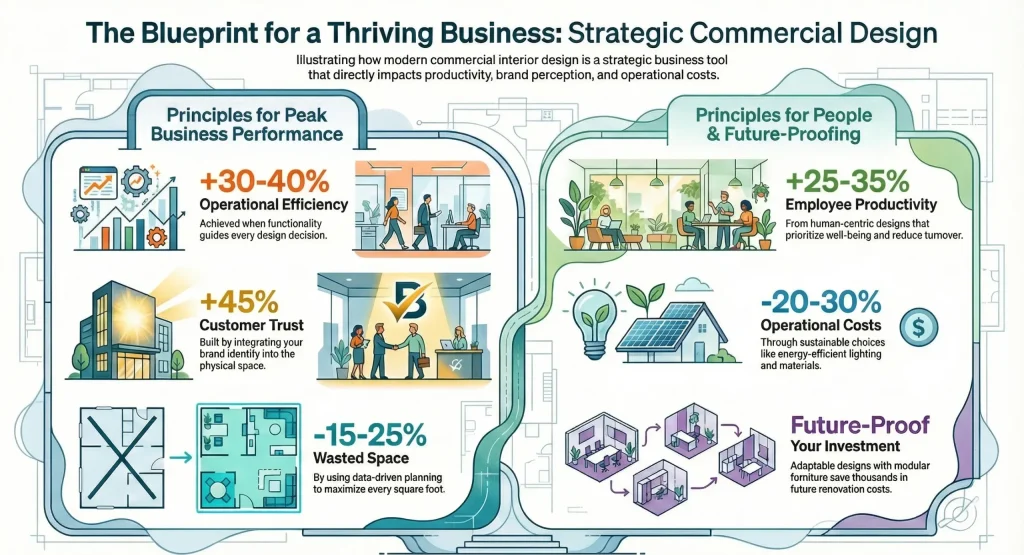
Future-proof design acknowledges that business needs constantly evolve. Modern commercial interiors incorporate modular furniture systems, movable partitions, and reconfigurable layouts that adapt without requiring complete renovations.
Technology infrastructure must also be flexible—power outlets at multiple locations, wireless connectivity throughout, and cable management systems that accommodate changing equipment needs. This adaptability saves businesses thousands in renovation costs when operations change.
3. Brand Identity Integration
Your commercial space is a three-dimensional brand experience. Modern design principles demand that every visual element reinforce brand identity—from colour palettes that match brand guidelines to materials that reflect brand values.
A tech startup might use industrial materials and open layouts to communicate innovation, while a luxury boutique employs premium materials and intimate spaces to convey exclusivity. Consistent brand expression across physical environments increases customer trust by 45% according to recent studies.
4. Employee Wellness and Productivity
Human-centric design recognizes that employee satisfaction directly impacts business performance. Modern commercial interiors prioritize natural lighting, air quality, ergonomic seating, and biophilic elements like plants and natural materials.
Wellness-focused features include:
- Sit-stand desks and ergonomic workstations
- Break areas promoting mental health
- Acoustic solutions reducing stress from noise
- Temperature control for individual comfort zones
5. Sustainable and Eco-Conscious Choices
Environmental responsibility isn’t just trendy—it’s essential. Modern commercial design emphasizes energy-efficient lighting, sustainable materials, low-VOC paints, and waste-reduction strategies.
Green design benefits extend beyond environmental impact—they reduce operational costs by 20-30% through lower energy bills and maintenance, while appealing to increasingly eco-conscious customers and employees.
6. Technology Integration
Smart building systems are fundamental to modern commercial spaces. This includes automated lighting and climate control, integrated AV systems for presentations, seamless connectivity infrastructure, and security systems that enhance both safety and operational efficiency.
Technology should be invisible yet accessible—wiring concealed, interfaces intuitive, and systems reliable. Poor technology integration creates frustration, while seamless implementation enhances user experience and operational efficiency.
7. Strategic Space Planning
Efficient space utilization maximizes ROI from every square foot. Modern design principles eliminate wasted circulation space while ensuring comfortable movement, create multi-purpose areas that serve different functions throughout the day, and balance private, focused zones with collaborative open areas.
8. Sensory Experience Design
Modern commercial interiors engage all five senses—not just visual aesthetics. Acoustic design controls noise levels to create appropriate environments; olfactory elements like signature scents enhance brand memory; tactile materials communicate quality through touch; and even thermal comfort affects how long customers stay and how productively employees work.
This multi-sensory approach creates memorable experiences that differentiate businesses from competitors and encourage repeat visits and longer engagement.
Implementing Modern Design Principles Successfully
These principles work synergistically—focusing on one while ignoring others creates imbalanced spaces that underperform. Successful commercial interiors integrate all principles into cohesive design strategies aligned with specific business objectives.
Professional commercial design expertise ensures these principles aren’t just understood theoretically but applied practically within budget constraints and timeline requirements. The difference between average and exceptional commercial spaces lies in the strategic implementation of these fundamental principles.
When planning commercial interior projects, partnering with experienced designers who demonstrate a deep understanding of modern design principles and business impact ensures investments deliver measurable returns.
Northwest Interiors brings 15+ years of expertise in creating functionally superior, brand-aligned commercial spaces across the retail, office, hospitality, and healthcare sectors in Chennai, Madurai, Trichy, and Coimbatore.
Modern commercial design isn’t about following trends—it’s about applying timeless principles that create spaces where businesses thrive, and people flourish.